Give it a GitHub issue. Get back a tested pull request.
Rivet is an autonomous software engineer. It plans a fix, writes the code in an isolated sandbox, runs the project's own tests, has a second agent review the change, and opens the pull request, recording every step along the way.
Open source under the MIT license. Runs on your own machine.
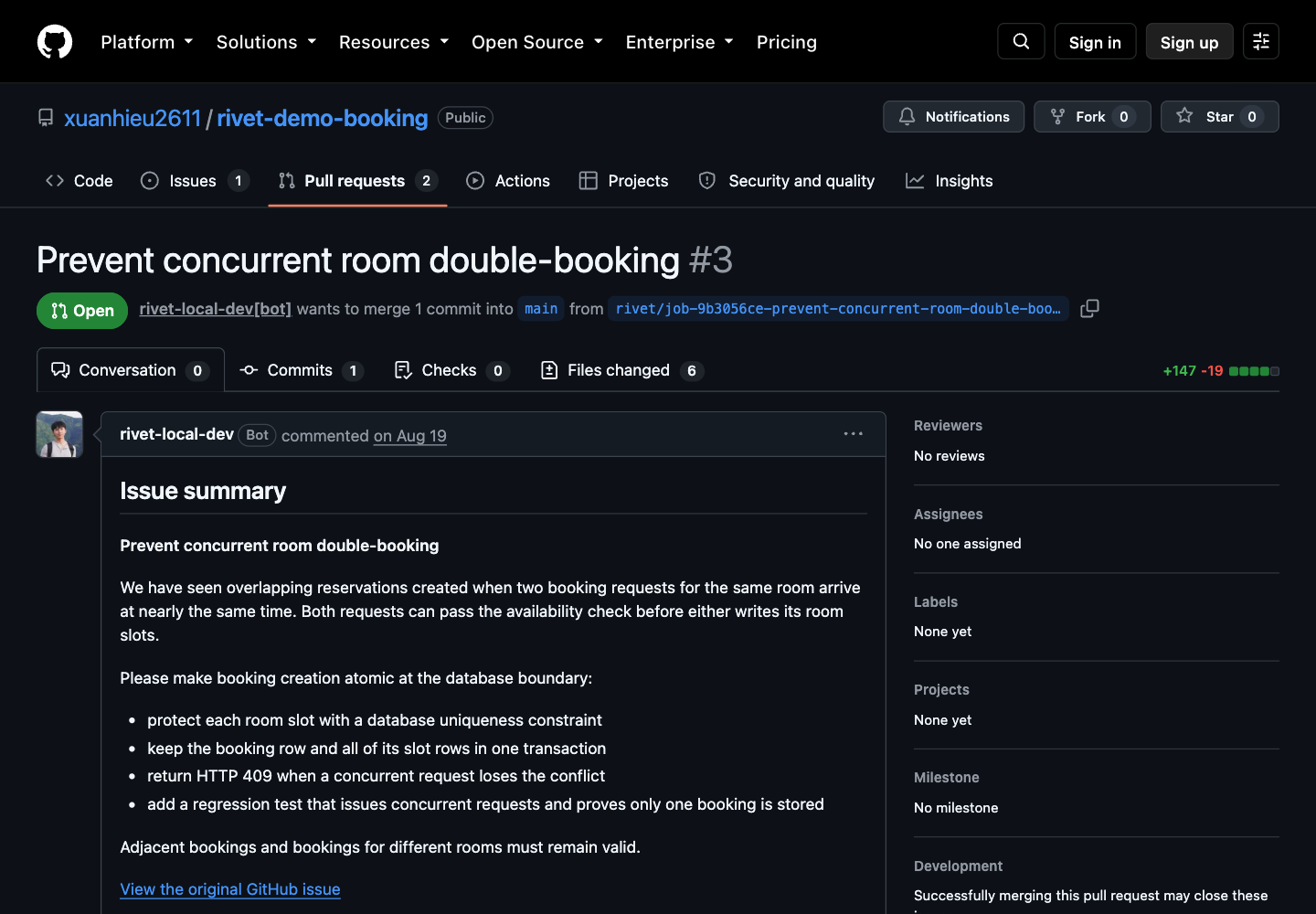
Prevent concurrent room double-booking
xuanhieu2611/rivet-demo-booking issue #1
- Provision
- Baseline
- Plan
- Implement
- Validate
- Review
- Publish
- 00:00Job created from issue #1
- 00:01Provision sandbox
- 00:03Container e7d6c8790de0 is up
- 00:03Seeded the repository at main (3e925b7)
- 00:03npm ciexit 0
- 00:03Record the baseline
- 00:03npm run testexit 0
- 00:03npm run typecheckexit 0
- 00:04npm run lintexit 0
- 00:04Baseline is green before any change
- 00:04Create plan
- 00:05Planner started with read-only tools
- 01:55submit_plan rejected: fields over 500 characters
- 02:22“Items need to be under 500 characters each. Let me shorten them.”
- 02:22Implementation plan recorded
- 02:22Implement change
- 02:22Implementer started inside the sandbox
- 04:35“errcode 2067 is SQLITE_CONSTRAINT_UNIQUE.”
- 04:35edit (sandbox)
- 04:35write (sandbox)
- 05:08“Now let me add the concurrent regression test.”
- 05:32edit (sandbox)
- 05:51“All 6 tests pass.”
- 06:06Validate change
- 06:06Diff recorded: 6 files, +147 −19
- 06:06npm run testexit 0
- 06:06npm run typecheckexit 0
- 06:06npm run lintexit 0
- 06:06Verified against the baseline
- 06:06Review patch
- 06:06Reviewer started with read-only tools
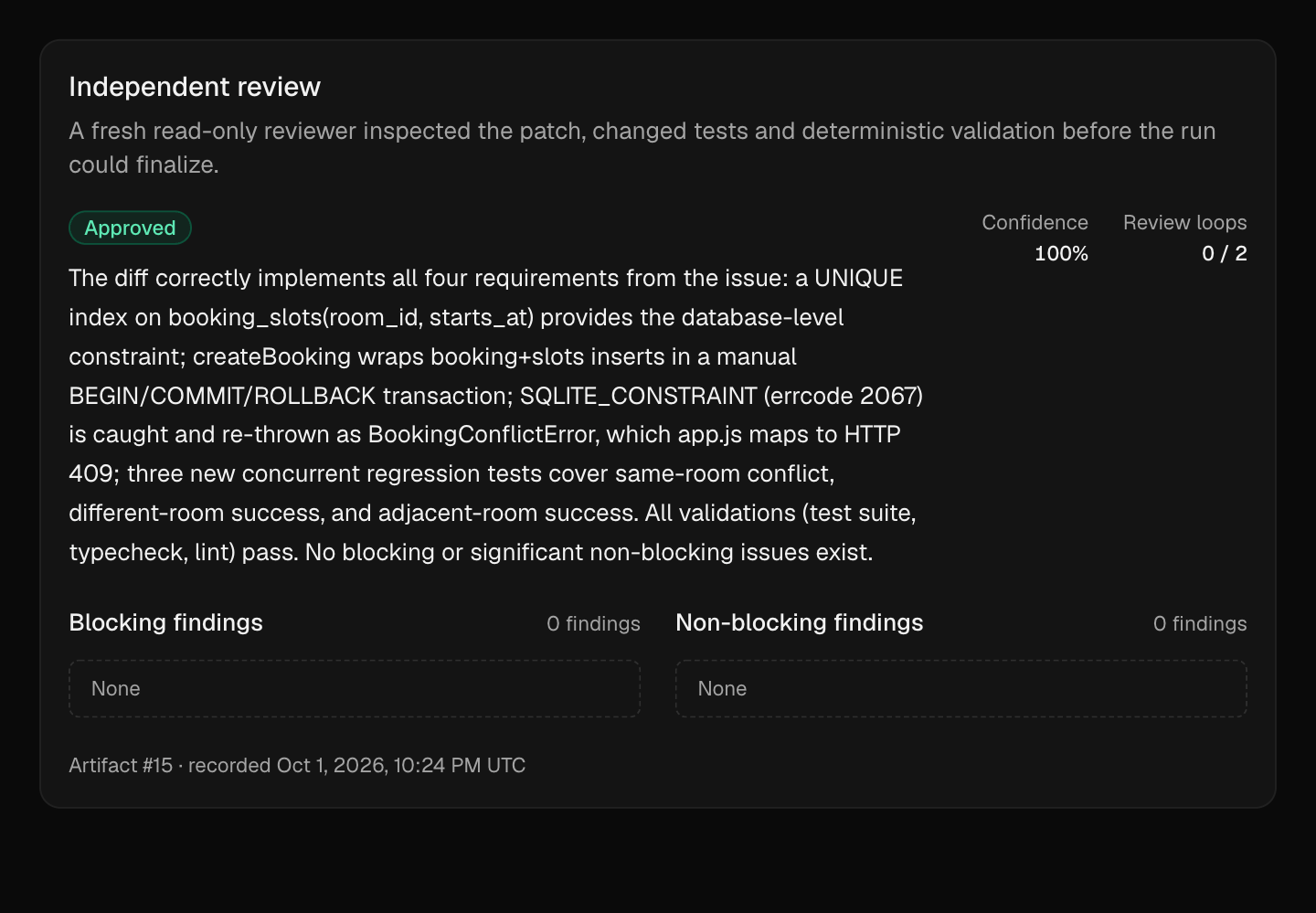
- 07:26Approved with 0 blocking findings
- 07:26Publish
- 07:30Committed rivet/job-9b3056ce-prevent-concurrent…
- 07:30Pushed the branch to GitHub
- 07:31Opened pull request #3
- 07:32Job completed
6 files changed, +147 −19, 24 model calls, $0.0141
A real job from August 20, 2026, replayed from its recorded event log at about 25 times speed.
- 7m 32s
- from issue to pull request in the run above
- 1.4¢
- of model usage for its 24 model calls
- 15 of 15
- benchmark tasks passed hidden tests with review
- 1,400+
- automated tests, from unit tests to real containers
How it works
Six steps, each one recorded. The screenshots come from the same job the console above replays.
01
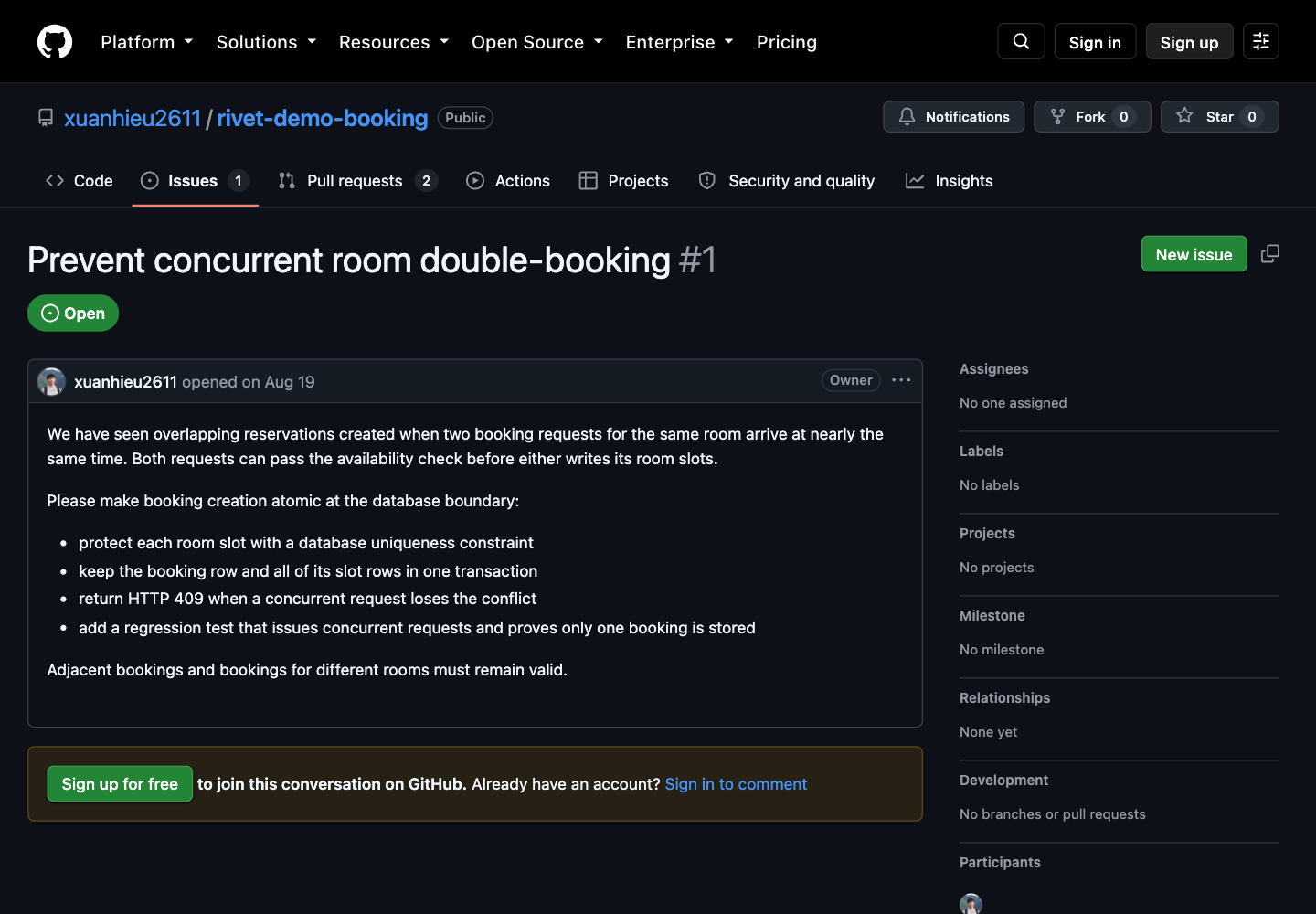
Start from an issue
Pick a GitHub issue, or describe the task yourself. Rivet clones the repository into a fresh, disposable container and records how its tests, typecheck and lint behave before anything changes.
The baseline matters later: it is how Rivet tells a failure it caused from one that was already there.
02
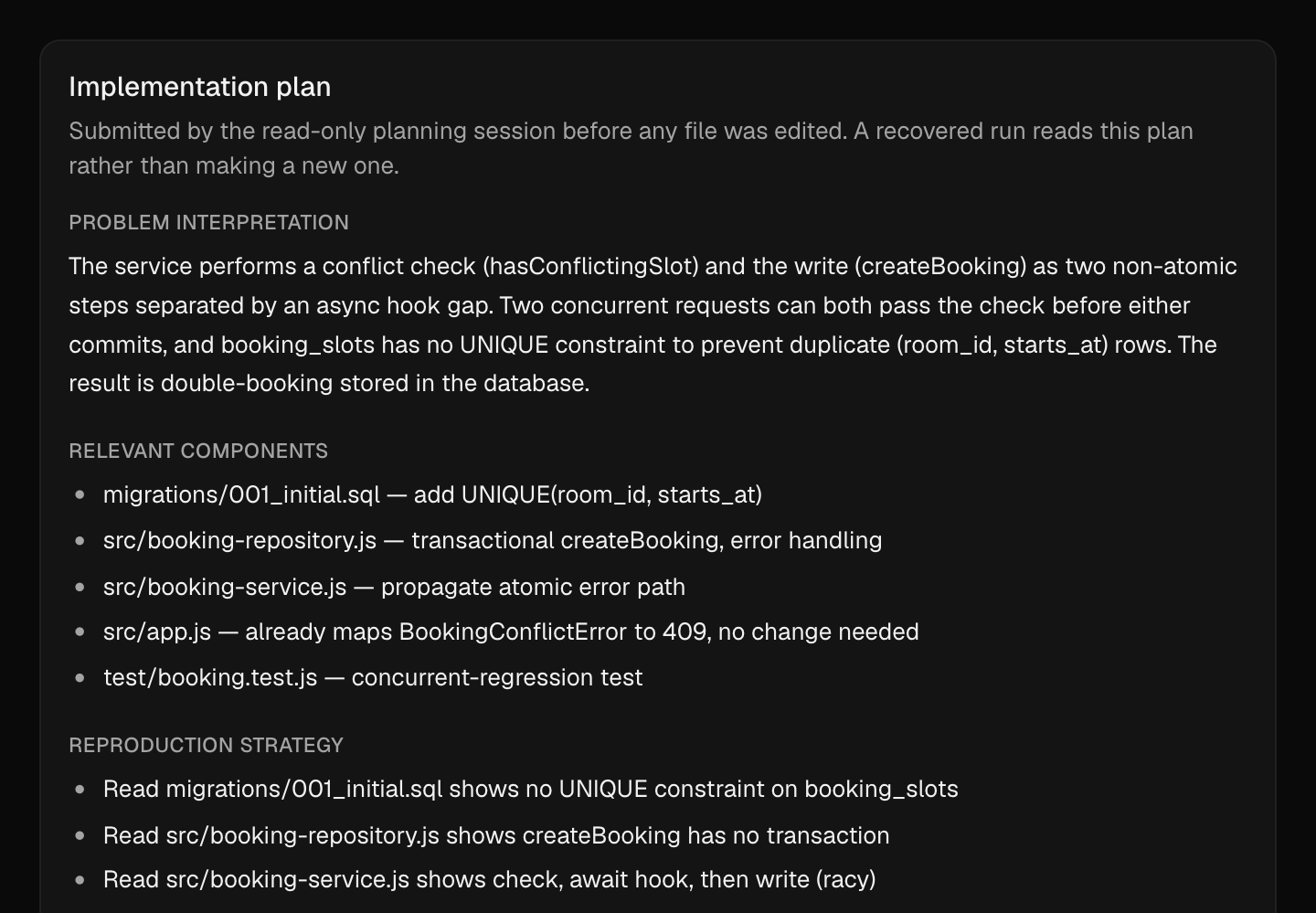
Plan before touching code
A planning agent reads the codebase and writes a structured plan: what is wrong, which files matter, how to reproduce it, how to fix it, and how to prove the fix.
The planner can list, read and search files. It has no tool that can edit one, and Rivet checks that before the session starts.
03
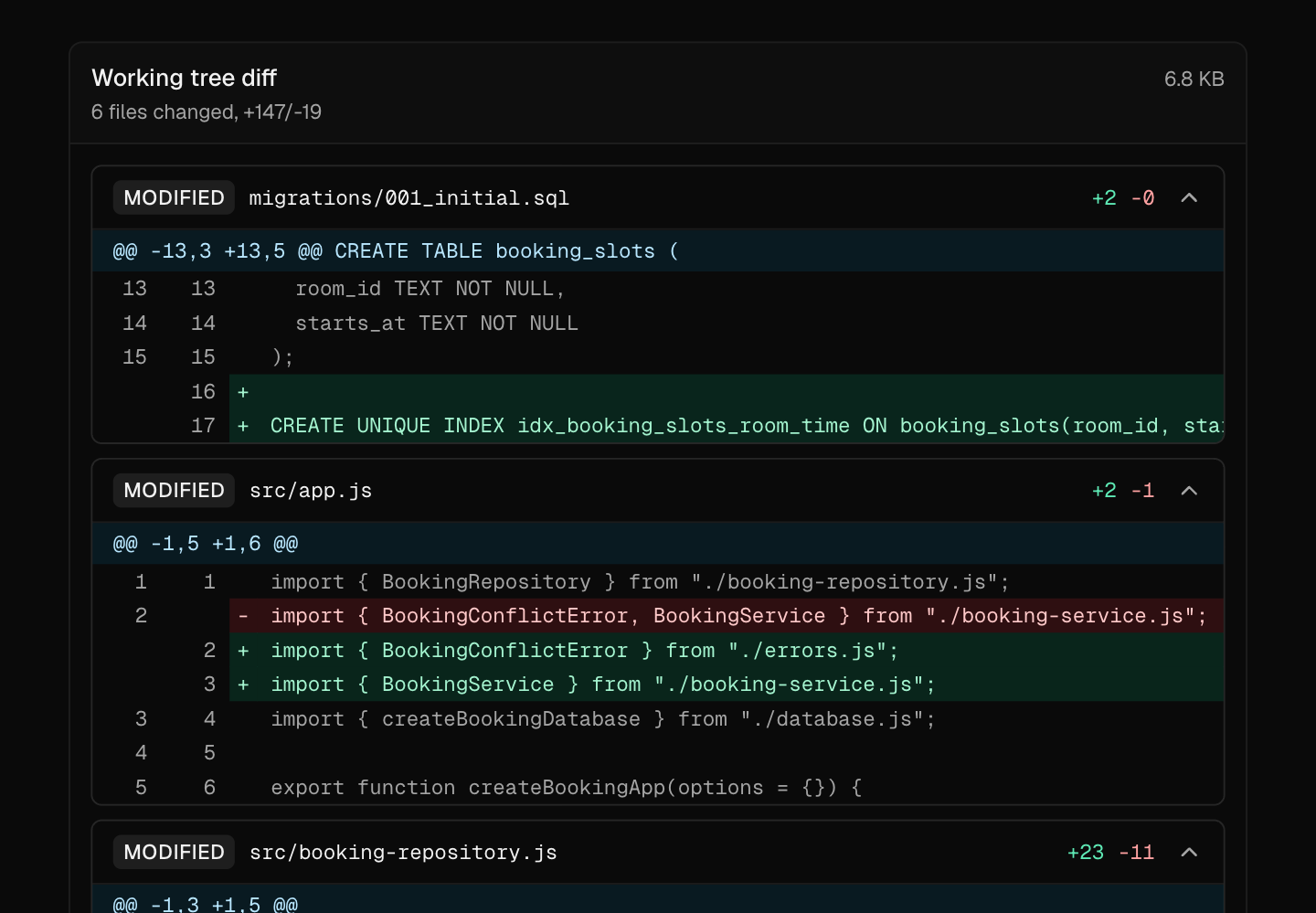
Write the change in a sandbox
A coding agent makes the change inside the container, running commands and tests as it goes. Progress is saved after every step.
Each step is a checksum-verified Git patch, so if a worker crashes, a replacement resumes from the last good step instead of starting over.
04
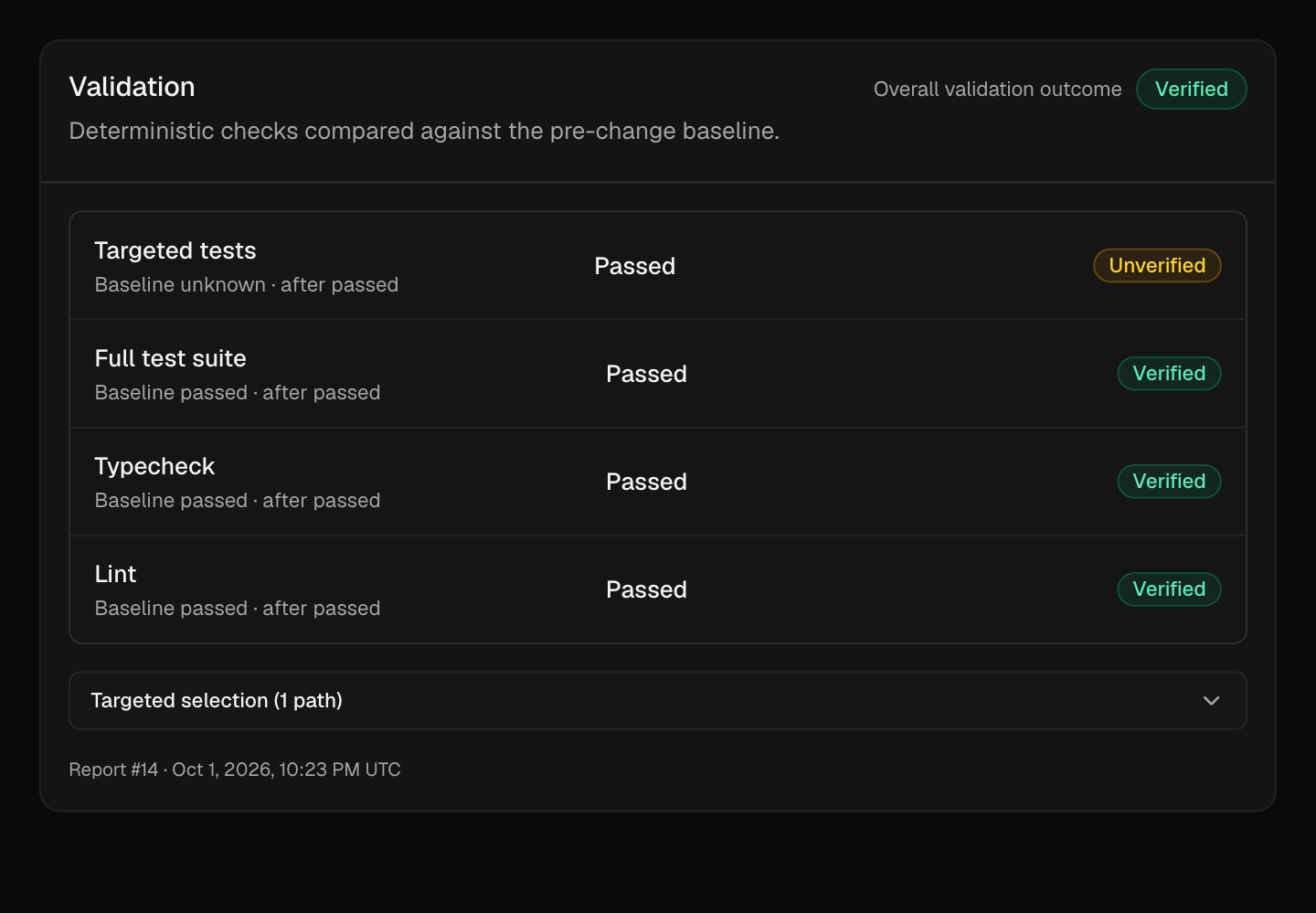
Check the work
Rivet reruns the project's own tests, typecheck and lint, then compares each result with the baseline from step one.
New test failures are named individually, so a suite that was already red cannot hide a regression the change introduced.
05
Get a second opinion
A separate reviewer agent reads the issue, the plan, the diff and the test results. It approves, or sends specific feedback back for another round.
The reviewer is read-only, and Rivet, not the model, decides how many revision rounds a job is allowed.
06
Open the pull request
Rivet commits the validated change, pushes a branch and opens an ordinary pull request for a person to review and merge.
Every GitHub action records a receipt first, so a retry or a recovered job never pushes twice or opens a duplicate pull request.
Step 1 of 6: Start from an issue
Demo video
Built to be trusted with a real repository
Having a model write code is the easy part. Most of Rivet is the system around it: what happens when something fails, what the AI is allowed to touch, and how you know the result is right.
- It survives a crash
- Kill the worker mid-job with kill -9. Another worker claims the job, rebuilds the sandbox from the last checkpoint, verifies its SHA-256, and carries on. A checkpoint that fails verification stops the job; Rivet never quietly starts over.
- It contains the AI
- The model's API key never enters the container running the cloned code. Each agent gets an exact set of tools, so the planner and the reviewer cannot write a byte, and Rivet verifies that set in code before every session.
- It tells the truth about tests
- Every check runs before and after the change. A test failure the change introduced fails the job, even in a suite that was already red; failures that were already there are reported as pre-existing.
- It acts on GitHub exactly once
- Pushes and pull requests write a receipt to Postgres before the job moves on. A retry, a reclaim or a second worker reads the receipt instead of repeating the action.
- You can watch it think
- Every phase, command, model call and GitHub request is an OpenTelemetry span, and the browser streams the job's append-only event log live. Budgets cap model calls, tokens, cost and wall-clock time per job.
- It measures itself
- An evaluation harness runs benchmark tasks as ordinary jobs, then grades each result in a second container against hidden tests the agent never saw.
How the pieces fit
Built with
- Interface
- Next.js 16, React 19, server-sent events
- Orchestration
- Node.js worker, PostgreSQL with Drizzle, Redis with BullMQ
- Execution
- Docker sandboxes, the Pi agent harness, models via OpenRouter
- Integration
- A GitHub App with short-lived installation tokens
- Operations
- OpenTelemetry, Grafana, Tempo, Prometheus
- Quality
- TypeScript (strict), Vitest, 1,400+ tests, CI on every push
Does a second reviewer help?
Rivet can run a job with or without the independent review step. So it was measured rather than assumed.
Independent review
15/15tasks passed hidden tests
- Model cost, all runs
- $0.0675
- Median runtime
- 143s
No review
14/15tasks passed hidden tests
- Model cost, all runs
- $0.0469
- Median runtime
- 95s
5 benchmark tasks, each run 3 times with and without the reviewer, and graded against hidden tests. With review, every run passed. It cost $0.0206 more across all fifteen runs and took about 52 seconds longer per run.
Fifteen runs per side is a small sample: one extra pass is a signal, not proof that the reviewer caught a bug. The write-up says so, which is the point of measuring.
Run on August 17, 2026 with DeepSeek V4 Flash via OpenRouter. Read the experiment
Built by Hieu Le
I built Rivet to find out what it takes to trust an AI agent with a real repository. The model turned out to be the easy part. The work is everything around it: sandboxes, crash recovery, honest validation, and a record of every step that anyone can check.
Run it yourself
Rivet is a self-hosted, single-operator application. Clone it, start Postgres, Redis and Docker, add a model key, and point it at a repository.
$ git clone https://github.com/xuanhieu2611/Rivet.git
$ cd Rivet && pnpm install
$ pnpm db:migrate && pnpm dev